Kalan Jarvis-Loewen
Hi, I'm Kalan. I'm a second-year Computing and Mathematics student at Queen's, and I like building things from the ground up to see how they really work.
This is where I keep the projects I'm proudest of, and a bit about who I am. If you only have a minute, the résumé has the short version.
Or keep reading for the longer version.
About
I wrote my first program when I was nine and never really stopped. For years that meant websites. The first one I'd still show anyone is a Pokémon card marketplace I built in 2021, with listings, accounts and a Firebase backend. After that came a Manchester City chant collection, a volunteer-hour tracker for nonprofits, and eventually sites for paying clients.
Somewhere along the way I got more interested in what's underneath. Libraries are great until you want to know why something works, so a lot of my projects rebuild things by hand: a language model in nothing but NumPy, which took over a day to train; LoRA straight from the paper; a man-in-the-middle toolkit built from raw packets. It's slower, but it's the only way I've found to properly understand something.
Some of it comes straight from my own life. I've lifted for years, and body fat is one of the hardest numbers to know without a scan. Communities like r/guessmybf crowdsource it from photos, so I trained LeanAI on thousands of those posts to do the guessing instead.
I'm currently on the QMIND design team, researching whether CLIP's idea of a word matches what people can actually see, and I build websites for local businesses and cinematographers on the side.
Outside of code, I lift, play soccer and chess, and read. I also spend a fair amount of time on math and LeetCode. I split my time between Kingston and Vancouver.
Right now
- Researching CLIP and human perception with QMIND
- Second year of Computing and Mathematics at Queen's
- Building client websites on the side
- Looking for a summer 2027 internship
Projects 5
LLM From Scratch
2025A decoder-only transformer written without ML frameworks, with LoRA implemented by hand.
Python · NumPy · Next.js
LLM From Scratch
2025- Role
- Solo
- Architecture
- 6 blocks, 8 heads each
- Framework
- None. NumPy only
- Final loss
- 0.66
- Extras
- LoRA, cosine LR decay
Overview
In this project I created an LLM (Large Language Model) from scratch, without the aid of libraries such as PyTorch or TensorFlow. Taking on such a challenge is important to my personal development as it allows me to understand LLMs in a practical, encompassing manner, in all of the complexity which modern libraries often take away. While getting the basic structure of the LLM was the most important task, this project allowed me to implement advanced methods such as LoRA (Low-Rank Adaptation) and learning rate decay (cosine, linear).
Problem
Libraries like PyTorch hide most of what's interesting about how a transformer learns. I wanted to write every piece myself, the forward pass and backpropagation included, so I'd understand the maths rather than the API.
Approach
While my model doesn't rely on libraries to take on the complexity of modern LLM logic, I was still able to implement a state of the art structure, particularly the self-attention head. Outlined in “Attention Is All You Need” (2017), self-attention is arguably the most important breakthrough in modern machine learning. I implemented a multi-headed self-attention structure, where each transformer had 8 self-attention heads.
Each transformer also had a simple hidden layer with non-linear activation (ReLU), two LayerNorms and a residual connection. Six of these transformers, along with the embedding and positional matrices, make up my from-scratch LLM.
Outcome
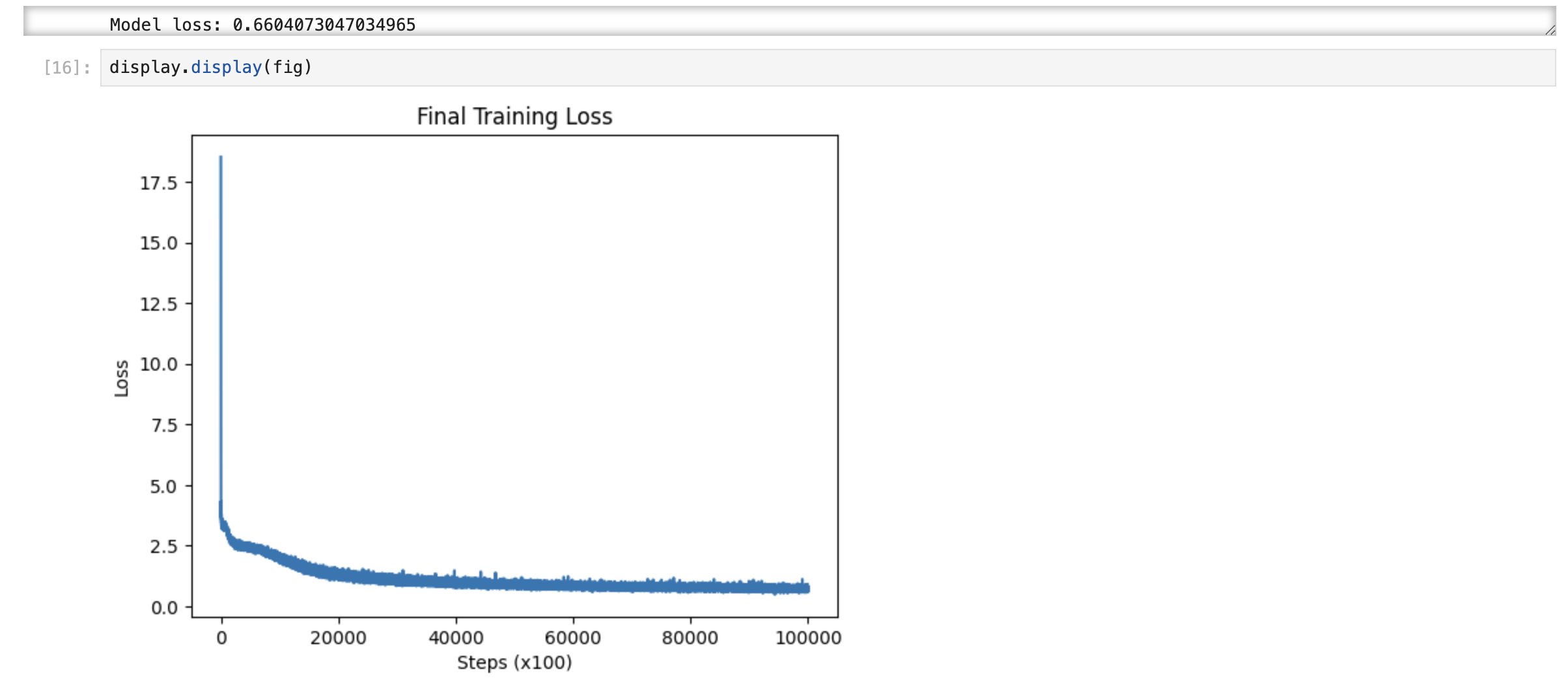
The base model trained on the source code of Python's requests library, about 10,000 lines. Training took over 24 hours and reached a training cross-entropy loss of 0.66, which means that on average the model gives the correct next character a probability of about 0.52.
I didn't want to leave it as a notebook, so I built a Next.js interface backed by a Hugging Face Space. You can prompt the model, adjust temperature and generation length, and see its attention heatmap.
Next
Swap character-level tokens for a subword tokenizer, and train on a larger corpus to see how far the same architecture scales.
LeanAI
2025Body-fat estimation from physique photos, served by an ensemble of eleven image models.
PyTorch · FastAI · FastAPI · Docker · Next.js
LeanAI
2025- Role
- Solo
- Task
- Body-fat % regression
- Models
- 11 CNN ensemble
- Serving
- Hugging Face, FastAPI
- Accuracy
- ±2.0 pts MAE
Overview
LeanAI is a machine learning powered web app which helps anyone reach their fitness goals. Given a few physique photos and basic metrics (weight, height), LeanAI predicts body-fat percentage.
Problem
Accurate body-fat measurement usually means a DEXA scan or calipers, which most people don't have. Public photos paired with DEXA results barely exist, so I trained on what does: about 1,600 physique photos from r/guessmybf and r/bulkorcut, labelled with the community's estimates. GPT-3.5 Turbo filtered the comments down to serious guesses before averaging.
Approach
The core model is a PyTorch ensemble of 11 image regression models, among them ResNet-50, EfficientNet-B3, DenseNet-121, RegNetY-040, GhostNet and MaxViT-Tiny. Each was trained on public body-fat estimation data with varying augmentation, using FastAI to streamline training.
The ensemble runs behind a FastAPI server, containerized with Docker and hosted on Hugging Face. A Next.js frontend calls that API, so the heavy model code stays off the web server and predictions come back in real time.
Outcome
Each model was trained with MSE loss, then judged by mean absolute error on 316 held-out photos. The best single model, MobileNetV3, was off by 2.09 percentage points on average. Averaging all eleven brought that to 2.01, so a prediction of 15% is typically within about two points of the community's estimate.
Cropping every photo to the body with pose detection made the data more consistent, and after that every model's error stayed under 3 points.
Next
The labels are crowd estimates, not measurements. The next step is checking the model against a small set of photos with real DEXA results.
Visibility Thresholds
2026Optimizing images toward words to test whether CLIP holds concepts humans can actually see.
PyTorch · CLIP · CLIPDraw
Visibility Thresholds
2026- Role
- Design team
- Model
- CLIP ViT-B/32
- Renderers
- Pixel, CLIPDraw, hybrid
- Evaluation
- Four-choice human game
- Results
- In progress
Overview
A QMIND design-team project asking whether high CLIP similarity scores correspond to concepts people can actually recognize, and how that changes across image types: raw pixels, vector strokes, and a hybrid of the two.
Problem
CLIP gives high image–text scores even for abstract words like “justice”. Does it have a visual concept humans would recognize, or is it pattern-matching?
Approach
Optimize an image to maximize CLIP similarity to a word, across words from concrete to abstract. Humans then guess the word in a four-choice game, and we compare their accuracy with CLIP's confidence.
The stimuli are 150 nouns sampled at low, medium and high imageability from the Glasgow Norms, cleaned with concreteness ratings and word-frequency data. Each word is drawn three ways: pixel-based feature visualization; CLIPDraw, which optimizes 256 coloured Bézier strokes through a differentiable renderer; and a hybrid that refines the stroke drawings with bounded pixel detail.
A batch runner draws every word with the same settings and seed, so results don't depend on word order. The full list is about 15 GPU-hours, so it's split across the team's Colab accounts.
Outcome
We presented the MVP at Camp QMIND to sponsor and faculty judges. The word list and drawing pipeline are done; results are pending the human recognition study.
Next
Run the four-choice study and compare human accuracy with CLIP's confidence at each imageability level, to find where the two diverge.
SYNapse
2025A modular man-in-the-middle toolkit: ARP spoofing, DNS spoofing and packet manipulation.
Python · Scapy · NetfilterQueue
SYNapse
2025- Role
- Solo
- Modes
- spoof, mitm, dns_spoof
- Platform
- Linux, iptables
- Version
- 0.1.0
- Distribution
- PyPI
Overview
SYNapse is an educational toolkit for hands-on experience with fundamental network security concepts. It moves beyond high-level frameworks to the direct crafting and manipulation of network packets, giving deep insight into how protocols like ARP, DNS and HTTP work, and how they can be subverted.
It is built with a modular architecture and intended for security researchers, students and network professionals in controlled lab environments.
Problem
ARP and DNS spoofing are easy to describe and hard to picture. I wanted to watch them happen at the packet level, so I built the tools myself instead of using an existing framework.
Approach
SYNapse is a Python command-line tool built on Scapy, with each attack as its own mode. spoof poisons the ARP caches of a target and its gateway, mitm adds live sniffing on top, and dns_spoof forges DNS responses for a chosen domain.
On Linux, iptables sends forwarded packets to NetfilterQueue, which hands them to Python to inspect, modify or drop before they continue.
Outcome
Version 0.1.0 has working ARP spoofing, man-in-the-middle and DNS spoofing modes, plus a sniffer with BPF filters. It's published on PyPI as synapse-toolkit, for use in labs on networks you're authorized to test.
Next
HTTP manipulation, automatic setup and teardown of the iptables rules, and support beyond Linux.
Build It, Break It
2025A full-stack app with token auth, built and then broken with SQL injection.
Next.js · Express · MySQL · sqlmap
Build It, Break It
2025- Role
- Solo
- Target
- Next.js client, Express + MySQL API
- Auth
- Token based
- Tool
- sqlmap
- Result
- Full database access
Overview
This project was a way to understand full-stack security interactively. I first built a full-stack MySQL and Next.js application with token authentication and a REST API. Once it was running, my goal was to exploit it through basic vulnerabilities that were purposely left open.
Problem
None of my apps had ever been attacked. I wanted to see them the way an attacker does, so I built an ordinary full-stack app and then broke into it.
Approach
The app is a Next.js frontend and REST API over MySQL, with token-based authentication. Once it was running, I left some vulnerabilities in on purpose and attacked the login route from outside with sqlmap.
Outcome
Using sqlmap, I gained complete access to the database from the outside. At first the app was too secure for the tool to work: I had to remove the login route's parameter checking to let malicious input reach the database. The lesson was thoroughness in backend SQL code: always use a function that takes a query and parameters, never just a query.
Next
Try other attack classes on the same app, such as cross-site scripting and broken authentication, then patch each one and confirm the attack stops working.
Experience
- 2026 — Now
Design Team Member at QMIND
Research on the QMIND design team, testing whether CLIP's idea of a word matches what people can actually see.
- Visibility Thresholds research: does CLIP hold visual concepts humans recognize?
- Presented the MVP at Camp QMIND to sponsor and faculty judges
- 2025 — 2026
Freelance Full-Stack Developer
Websites for local businesses and creatives, built and deployed end to end.
- Photography, videography, coaching and archive sites for local clients
- Next.js on Vercel, serverless backends on Google Cloud and Firebase
- Owned each build end to end: scope, design, deployment, DNS, SEO
- 2025 — 2029
Bachelor of Computing and Mathematics (Honours) at Queen's University
Computing and Mathematics (COMA) major.
Coursework
Winter 2027 · next term
- MATH 281Introduction to Real Analysis
- MATH 212Linear Algebra II
- STAT 269Statistics and Probability II
- CISC 235Data Structures
- CISC 221Computer Architecture
- CISC 223Software Specifications
Fall 2026 · in progress
- CISC 203Discrete Structures II
Sets, relations and functions, number theory, groups and combinatorics.
- CISC 204Logic for Computing Science
Proof systems for propositional and predicate logic, satisfiability, soundness and completeness.
- MATH 221Vector Calculus
Multiple integrals, vector fields, line and flux integrals, and the theorems of Green, Gauss and Stokes.
- STAT 268Statistics and Probability I
Random variables, distributions, expectation and moment-generating functions.
2025–26
- CISC 124Introduction to Computing Science II
Object-oriented programming in Java.
- CISC 121Introduction to Computing Science I
Programming in Python, with searching and sorting algorithms.
- STAT 161Introduction to Data Science and Statistics
Data analysis and statistics in Python and Jupyter.
- CISC 102Discrete Structures I
Smaller things 13
- 2026Veterans ArchiveA searchable archive of veterans' letters, photographs and oral histories, browsable by era, branch, format and keyword.
- 2026Website ProspectorFinds local businesses without a website and ranks how much each needs one.
- 2025LoRA From ScratchThe LoRA paper implemented by hand on a base Hugging Face model.
- 2025JMAI.PHOTOSPhotographer portfolio with a hand-rolled masonry gallery and a gated inbox.
- 2025Acting CoachingBooking and services site for a Vancouver theatre educator.
- 2025Videography PortfolioPortfolio site for a videographer client.
- 2025Insertion Sort, InteractiveStep through insertion sort by choosing swap or stay at each comparison.
- 2024QuickStudyGPTTurns study notes into fill-in-the-blank quizzes with the OpenAI API.
- 2024QuantrackVolunteer-hour tracking for nonprofits, with verified organizations.
- 2024MCFC Fan ChantsManchester City chants and songs, with fan suggestions, comments and likes.
- 2023MySQL Full-Stack AppA REST backend over MySQL with Prisma, paired with a Next.js frontend.
- 2022newsFinderScrapes ten news sites and matches similar headlines across them.
- 2021Pokémon Cards MarketA trading-card marketplace. The first project here.
Tools I use
- Languages
- Python, TypeScript, Java
- ML
- PyTorch, FastAI, NumPy, Pandas, scikit-learn
- Backend
- FastAPI, Node.js, Redis, Docker, MySQL, MongoDB
- Frontend
- Next.js, React, Tailwind CSS
- Cloud
- Google Cloud, Firebase, Vercel, Hugging Face
Contact
Email is the best way to reach me.